Exploring the Legacy of Laurel and Hardy in Theatre

Updated: 3 hours ago
Laurel and Hardy have left an indelible mark on the world of entertainment. Here, we delve into the legacy of Laurel and Hardy, examining their impact on popular culture, the evolution of comedy, and how their work continues to inspire artists today.

The Origins of Laurel and Hardy
Both Stan Laurel and Oliver Hardy started their working lives in theatre, Ollie as a vaudeville singer and Stan as a silent actor.
A little known fact about Stan Laurel is that he started out as Charlie Chaplin's understudy (there is an anecdote that Laurel and Chaplin shared a berth on a boat trip between the UK and the US during a tour; the story goes that Stan was cooking in their cabin - something which was forbidden - and Chaplin played the violin to disguise the noise). Another anecdote tells us that at the time, Stan was viewed as an inferior artist to Charlie - an opinion that seems to be borne out by Stan himself (Stan's own words: "I don't deserve to be mentioned in the same sentence as Chaplin" are represented in The Lives and Deaths of Laurel and Hardy).
Laurel (then called Stanley Jefferson) and Chaplin worked for impresario Fred Karno's Comedy Troupe. In an effort to circumvent censorship rules (and avoid paying writer's royalties), Fred Karno pioneered a type of wordless, silent theatre. Often credited as being the inventor of the 'custard pie in the face gag', we can only conjecture how much silent film tropes and styles owe to Karno's inventiveness, passed on through artists such as Chaplin and Laurel.

Oliver Hardy (christened Norvell Hardy - he started calling himself Oliver at the age of eighteen in remembrance of his dead father; he went by the nickname Babe for all his film career, and this is what Stan Laurel called him off camera) was a trained singer. Like Stan, there are anecdotal reports about his early career. One is that he ran away from home at the age of eight to join a singing group he met at his family boarding house, to be returned by them a few weeks later. Whatever the truth of this, we do know for sure that his talent for music was eventually recognised, because his mother sent him for singing lessons at the Atlanta Conservatory of Music. Reports state that his teacher considered him talented but 'lazy and lacking ambition'.
Ollie was however, a good enough singer to get work with a vaudeville touring company - but it was his job as a projectionist in a local 'electric theatre' (the early name for a cinema), that inspired him to become a film actor, and sealed his fate as one half of the world's most famous comedy duo.
The film the two first appeared in together was Lucky Dog, shot for 'Broncho Billy' Anderson's production company and really meant as a vehicle for Stan. Ollie appears as a 'heavy' - a threatening villain stock character. It was Hal Roach under Rolin Films (with whom Stan and Ollie made all their best-known and best-loved films) who claims to be the person who put Stan and Ollie together as a pair. The rest is history.
The Comedy Timeline
Looking at the two icons positioned, as it were, on a historical comedy timeline, it is fascinating to consider at what point the particular genre we think of as 'the comedy of Laurel and Hardy' falls.
The physical slapstick comedy that Fred Karno's troupe were embracing and which was later developed in silent film certainly dates back to the 1600s and commedia dell'arte. The 'slap stick' was a physical stick called a batacchio, which was a bit like a clapping board and made a loud 'slapping' noise when used by one actor hitting (or pretending to hit) another.

Punch and Judy shows are documented in England as early as 1662, and were directly influenced by commedia dell'arte (the character Punch is derived from the commedia dell'arte character Pulcinella). Samuel Pepys is documented as having seen the show in Covent Garden and described it as "An Italian puppet show...the best I ever saw." Punch and Judy shows also employed the batacchio 'slap' effect, and a type of early whoopee cushion made from a pig's bladder.
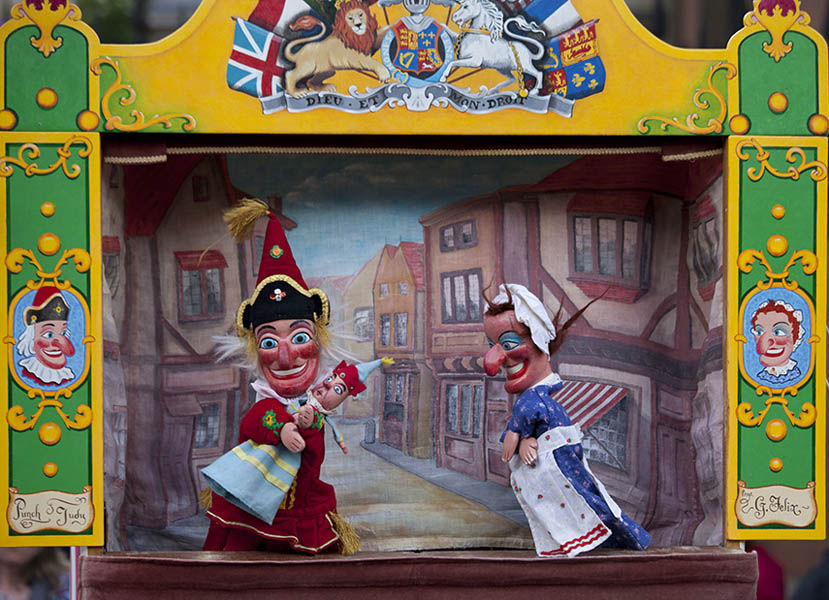
The cartoon violence and stock characters made their way into the kinds of slapstick and pantomime performances we associate with Victorian music hall (or American vaudeville) shows. It is worth noting that women were considered very skilled at 'slapstick' - particularly the 'pratfalls' (the act of falling onto the buttocks); women were able to pad under their skirts, a thing men could not do, and the most skillful of them could fall and 'bounce' back up in one fluid movement.
From commedia dell'arte, to Punch and Judy, to vaudeville, to Karno (sadly, no records of the Karno shows remain and we only have anecdotal reports of their form and content), we arrive at the silent film genre. In silent films (and the early talkies) we find the old tropes - cartoon violence, stock characters, exaggerated physicality, improbable scenarios - reimagined with the creation and antics of Chaplin's Tramp, The Keystone Cops, Harold Lloyd and Laurel and Hardy.
A New Art Form
Laurel and Hardy and other silent film actors may have started out following centuries-old comedy traditions which were rooted in early theatre, but the new technology of film soon created a more finely-nuanced art form. Close-ups could focus on details like facial expressions and small hand gestures (like Ollie's 'pinky out' when drinking a cup of tea). These things (like Hardy's tie-twiddle and Laurel's crying and hair-mussing, for example) began to create what we might call a more sophisticated form of comedy. We keep the tropes - the stock characters of pompous bully and inept fall guy, the catch phrases, the improbable scenarios, the slapstick violence - but Hardy's exasperated look into camera and his repeated plea of "Why don't you help me?" resonate with humanness on a level that comedy had not seen before.
The Legacy
Arguably, the pairing of the 'bully and fall guy' in comedic situations is perhaps the most obvious legacy of Laurel and Hardy. Just look at how powerfully the cartoons of Hanna-Barbera (Tom and Jerry, Sylvester and Tweetie Pie, Bugs Bunny and Elmer Fudd, the list goes on) have made it into our modern consciousness. Once you have an objective and a counter-objective (Sylvester wants to eat Tweetie Pie, Tweetie Pie does not want to get eaten), you have a 'drama'. Of course, we want the fall guy to come out on top!
However, Laurel and Hardy have pushed us further than this. As I stated earlier, their relationship is complicated. They are friends (best friends!) but somehow they cannot help getting in each other's way. They start with the same objective, but cannot help thwarting each other. The Music Box is a perfect example of this - they both want to get the piano to the top of the steps, but find that, although they think they are pushing in the same direction, they are actually pushing against each other. This mature commentary on the complicated nature of relationships is repeated in many modern-day situation comedies such as Fawlty Towers, Steptoe and Son, and Frasier.

We could also argue that Laurel and Hardy were the first popular artists to use comedy to express ideas about the futility of struggling against a chaotic and indifferent world. The Music Box is again a good example of this. Laurel and Hardy spend the majority of the film struggling (and enduring much pain and many setbacks in the process) to get a piano up a steep flight of steps - only to find upon reaching the top that they could have gone a much easier way around. And even when they achieve their goal of delivering the piano, it ends up in a pond anyway! The message of the film seems to be that the journey is long and painful, and the much-strived-for goal ultimately worthless.
Arguably, works like this directly influenced what we now call absurdist playwrights, such as Beckett and Ionesco. Some critics believe that the two bowler-wearing tramps in Waiting for Godot who 'play to pass the time' were directly informed by Laurel and Hardy.

The creative work of Laurel and Hardy (not forgetting others who contributed to their opus, such as producer Hal Roach and director Leo McCarey) has roots as far back at the 1600s. Yet it has also forged new paths which explore comedy as ways of expressing complicated relationships with people and the world.
In Theatre
In theatre, we have already looked at the influence of Laurel and Hardy in twentieth century absurdism. 21st-century playwright Peter Nichols (particularly in his play A Day in the Death of Joe Egg) uses dark humour to express the pain of a person trapped in tragic relationships, as well as referencing a music-hall slapstick comedy inheritance.
Recent productions continue to explore the tropes of farce and slapstick (The Play That Goes Wrong is a good example). Other plays directly inspired by Laurel and Hardy are
The Strange Tale of Charlie Chaplin and Stan Laurel by Paul Hunter and, in 2026, the new biographical play The Lives and Deaths of Laurel and Hardy by Donna K. Triggs.
Let us hope that new productions, in theatre, film and television, continue to do justice to the two Comedy Greats.
Comments